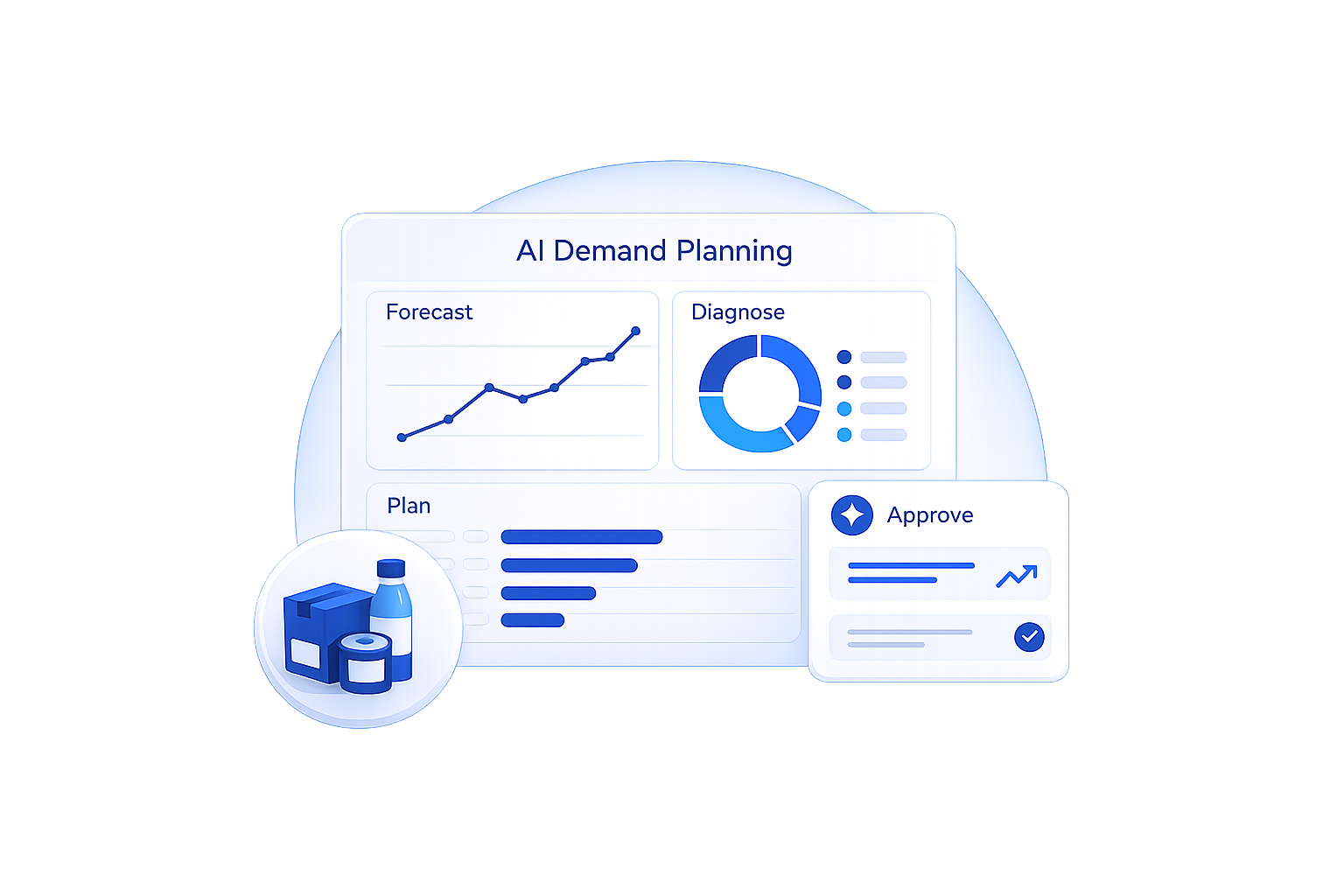
CPG case study

Empowering our clients through continuous and improved demand intelligence.

An AI-enabled planning system that helps teams understand what is changing, test what to do next, and make better pricing, promotion, distribution, and SKU-level product decisions.

Demand Planning Intelligence for CPG banner
Interactive demo

See the CPG planning cockpit in action.

A guided walkthrough of how planners move from an emerging demand signal to diagnosis, simulation, and a controlled commercial decision.

Video preview placeholder — final walkthrough coming soon.

How it works

From a changing demand signal to an updated commercial plan.

AI co-piloting helps planners monitor change, diagnose drivers and barriers, simulate scenarios, and decide what to do next.

Signal detected

Demand is moving off plan.

The AI co-pilot continuously watches sell-out, distribution, and promotion signals to flag deviations from baseline before they compound.

Demand vs. Baseline Actual Baseline
Root cause diagnosis

Here is what changed — and where.

The AI co-pilot decomposes the variance into likely drivers and barriers and points to the products, customers, and regions where the deviation is concentrated.

Where live regional concentration
Northeast 12 SKUs affected
Affected (Northeast) Other Census divisions
Scenario comparison

What happens if we change the plan?

Planners simulate pricing, promotion, and distribution options and compare projected impact on demand, revenue, and margin before committing.

Scenario comparison
Scenario Demand(Δ) Revenue(Δ) Margin(Δ)
Current plan
Extend promotion +4.2%+$310K+$82K
Targeted distribution +3.1%+$220K+$58K
What if we take price up 5%?
Planner decision

Choose what to do next.

The AI co-pilot proposes a recommendation with supporting evidence and expected impact. The planner reviews, adjusts, and approves.

Recommended action

Restore availability in affected clusters and extend the promotion by 1 week.

Expected uplift+4.5%
Revenue+$310K
ConfidenceHigh
Challenge

Demand plans become outdated as soon as the market behaves differently than expected.

Demand planning teams need to make fast decisions while reconciling changing signals across pricing, promotions, availability, distribution, local events, weather, and competitive activity. At the same time, shoppers increasingly move between in-store and digital channels — buying from the shelf, ordering through retailer websites and apps, or combining both. These changing shopping patterns can materially affect where, when, and how demand appears.

The problem is also one of visibility. Retailer- and account-level averages can mask important differences at the SKU, store, channel, and local-market level, hiding both emerging risks and commercial opportunities.

The real challenge is not producing another forecast. It is understanding what is driving demand, what barriers are holding it back, and how shopper behavior is shifting across physical and digital channels — then deciding how to respond while keeping Sales, Finance, Marketing, and Operations aligned with the same shared source-of-truth view.

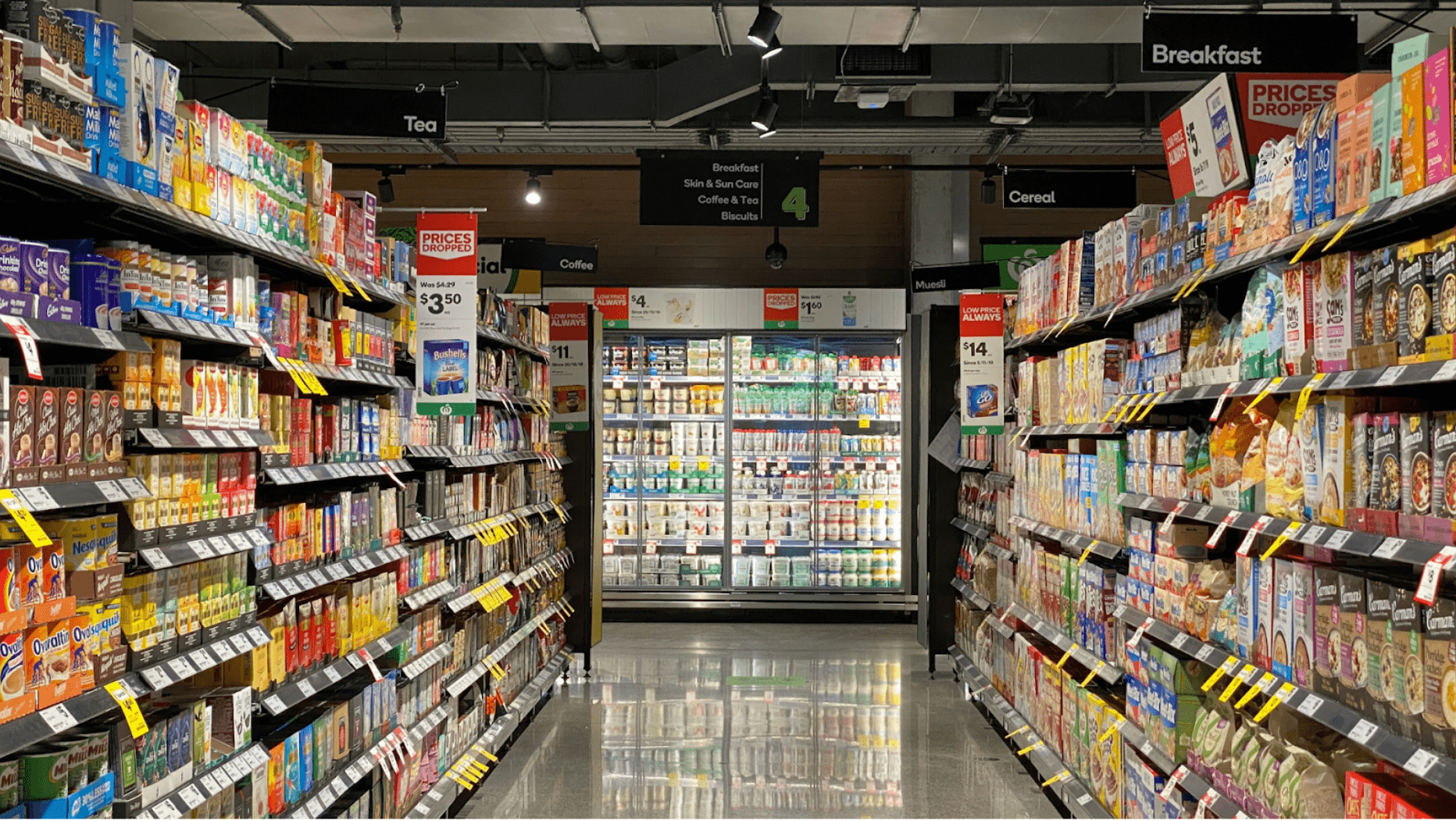
CPG retail store shelves representing shifting consumer demand
Spreadsheet-heavy planning
Local behavior hidden in averages
Slow forecast reconciliation
Unexplained sales deviations
Static scenario analysis
Lost planning context
The Traditional Way

When demand shifts, spreadsheet-based planning is already behind.

01

Hunt and gather fragmented data

Sales, pricing, promotions, distribution, inventory, and external signals are collected from separate systems and spreadsheets.

02

Time-intensive forecast adjustments

Planners create raw baseline forecasts and manually incorporate local knowledge, commercial assumptions, and expected market events.

03

Disconnected assumptions and data views

Sales, Finance, Marketing, and Operations review different assumptions through meetings, emails, and disconnected files.

04

Investigate deviations manually

When actual sales differ from plan, teams analyze products, customers, regions, promotions, and possible external causes.

05

Scenarios and learnings get lost

Alternatives are evaluated individually, while decisions, results, and business context are rarely preserved for the next planning cycle.

We solve for this — and more.

The Better Way

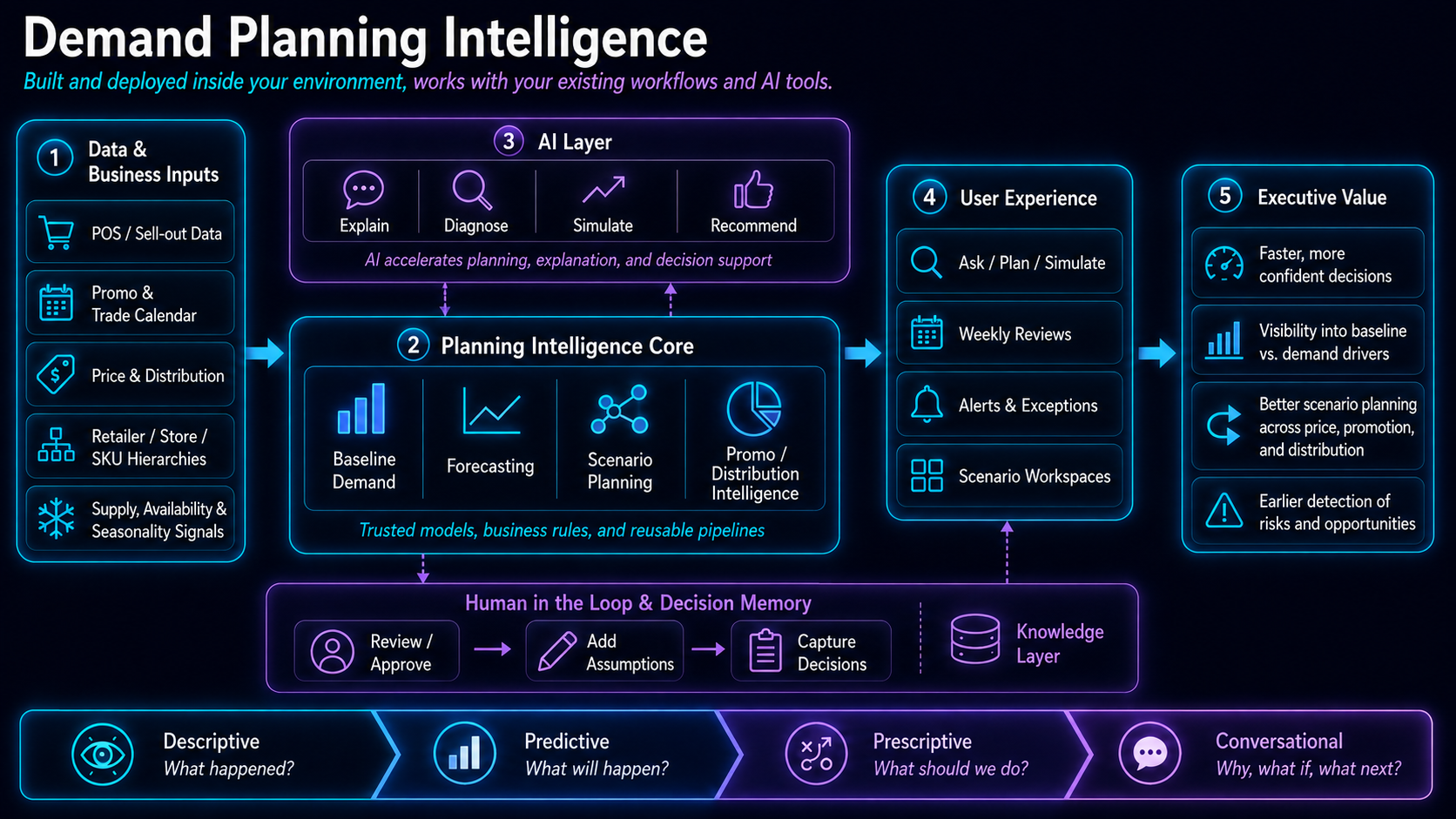
Qubit Nexus turns demand planning into a continuous intelligence workflow.

Built on a shared source of truth, the workflow brings demand signals, assumptions, scenarios, and decisions into one current planning view across the organization.

Demand Planning Intelligence solution diagram
01

Data & business inputs

Connect the core commercial and operational signals that shape demand planning, including POS or sell-out data, promotion and trade calendars, price and distribution, retailer / store / SKU hierarchies, and supply, availability, and seasonality signals.

02

Planning intelligence core

Establish the analytical foundation for better planning decisions. This layer combines baseline demand, forecasting, scenario planning, promotion and distribution intelligence, and SKU-level incrementality and cannibalization analysis inside one trusted planning core built on reusable models, business rules, and pipelines.

03

AI layer

Use AI to accelerate planning, explanation, and decision support. The AI layer helps teams explain results, diagnose changes, simulate alternatives, and generate recommendations based on the planning intelligence core.

04

User experience

Deliver the capability through a practical planning workflow. Teams can ask questions, plan and simulate scenarios, review results on a weekly basis, respond to alerts and exceptions, and work through dedicated scenario workspaces.

05

Executive value

Turn planning intelligence into measurable business value. The result is faster and more confident decisions, better visibility into baseline demand and its drivers, clearer understanding of true incremental growth versus demand shifting across the portfolio, stronger scenario planning across price, promotion, distribution, and product mix, and earlier detection of risks and opportunities.

Planner + AI

AI strengthens the planning process. Planners stay in control.

Planning engine

Builds baselines, forecasts demand, measures uplift, evaluates scenarios, and tracks accuracy and business impact.

AI co-pilot

Continuously monitors change, explains drivers and barriers, investigates anomalies, compares scenarios, and surfaces relevant evidence and prior learnings — reducing the manual work required to understand what is happening.

Demand planner

Adds market and customer context, tests assumptions, challenges recommendations, and makes the final decision — with more time to focus on judgment, action, and commercial opportunities.

Governance

Controls are built into the planning workflow, not added after deployment.

Planning risk Operational Control
Sensitive business data Client-controlled deployment, access controls, and approved data connections.
Weak or incomplete data Data-quality checks, completeness indicators, and exception handling.
Unsupported AI conclusions Evidence-backed outputs and mandatory planner approval before action.
Model drift and market shocks Continuous monitoring and controlled model updates.
Lack of auditability Logged assumptions, scenarios, recommendations, approvals, and outcomes.
Impact

From forecasting work to faster, more reliable commercial decisions.

The value is not only a more accurate forecast. Planners gain a faster way to understand changing demand, test commercial options, and align the business around a clear course of action.

Earlier alert and faster response

Detect meaningful demand changes sooner and move more quickly from signal to explanation and action.

More precise and reliable planning

Continuously evaluate forecast performance and improve confidence in the assumptions, models, and signals supporting planning decisions.

Better commercial decisions

Compare pricing, promotion, distribution, and product-mix scenarios while considering demand, revenue, margin, incrementality, and cannibalization.

More planner bandwidth

Reduce time spent gathering data, reconciling assumptions, and manually investigating deviations so planners can focus on judgment, opportunities, and action.

Stronger retailer and channel relationships

Bring better evidence into conversations with retailers and other channel partners, supporting more informed decisions around promotions, assortment, distribution, and trade investment.

How we work

Assess → Build → Expand

Assess

Understand the current planning environment and the quality of the foundation underneath it.

  • Data availability and quality
  • SKU and product harmonization
  • Retailer and store hierarchies
  • Data granularity
  • Forecasting inputs and methodology
  • Existing models and planning tools
  • Forecast accuracy, precision, and reliability
  • Current planning workflows
Build

Create the planning intelligence capability around a clearly defined business problem.

Start with the appropriate product, category, retailer, region, or planning decision. Connect and harmonize the required data and build the workflow for monitoring, diagnosis, simulation, and decision support.

A focused pilot can be used where appropriate, but Qubit Nexus also delivers complete planning capabilities that extend beyond a pilot.

Expand

Scale once the capability and value are established.

  • Additional SKUs and categories
  • Retailers and channels
  • Regions and store clusters
  • Pricing and promotion decisions
  • Distribution and assortment
  • New data sources
  • Additional planning workflows

Start where it makes sense for your organization and scale at the pace that creates value.

Ready to turn demand planning into a continuous commercial intelligence workflow?

Qubit Nexus helps CPG teams build AI-enabled demand planning and revenue management capabilities inside their own environment — connected to their data, models, planning workflows, business constraints, and existing technology stack.